A fascinating glimpse of the past
Published 5:00 am Sunday, February 22, 2026

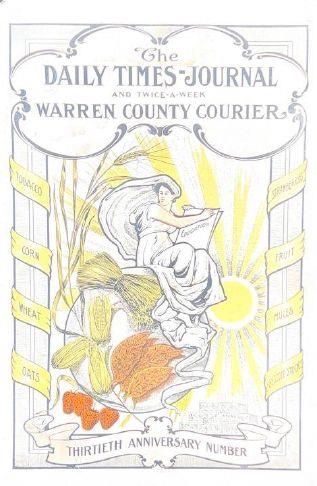

Local historian Ray Buckberry dropped off quite a treat recently — a high-quality reprint of a 1913 Daily Times Journal and Twice-A-Week Courier (yes that’s quite a mouthful) newspaper.
Historic newspapers are the best window on our past. The Daily News (under various names) has been publishing continuously since 1854, but existing (or online) issues before the early 1900s are quite scarce.
This newspaper is a special 30th anniversary edition of that particular publication, which was founded in 1882. It was owned and managed by the Denhardt family, which later produced Gen. William Denhardt, a prominent statewide political figure who is still remembered today in large part because of an infamous 1936 murder scandal involving his fiance.
This special section mostly features profiles of prominent local residents, businesses and churches.
The front-page illustration highlighted what Warren County was known for then: tobacco, corn, wheat, oats, strawberries, fruit, mules, “blooded stock” — apparently a reference to horses bred for racing, as well as building stone and education.
A full page of ads in the issue features businesses all long gone — McElroy-Page Co. (farm implements); Herdman & Stout (insurance) and The Victoria Limestone Co. The ad states the company’s limestone “is noted for its beautiful appearance when set in the building” and notes that the Bowling Green stone was being used to build the then-under construction Governor’s Mansion in Frankfort.
The articles within have many interesting tidbits:
•A July 5, 1911, fire was then considered to be the most destructive in city history. Lost were the McCormack Building and annex, the Christian Church and Patterson’s Livery Stable. The Times-Journal was housed in the McCormack building and the fire came as preparation work was underway for that evening’s paper. The paper came out on schedule that night, however, as the Daily News agreed to print the rival paper on its press.
•The high-quality limestone being taken from local quarries was the second “most important asset” for the community, trailing only the soil itself.
•According to the paper, “Bowling Green has more acres of ground set aside for parks than any other city of it size in the State.”
•What we call today Fountain Square Park was called Central Park.
•There is a reference to a large ax-handle factory somewhere in town. This is the at least the third reference I’ve seen to the factory from that period, so it must have been a large enterprise.
•Even then, immigrants were benefitting the community. A short profile of Sam Moskovits, born in Hungary, details how he went from a peddler who didn’t speak English to a prosperous owner of a clothing store and other businesses in town. Another profile notes that Martin DeVries, born in Holland, was one of the longest-tenured businessmen in town with his well-known bakery.
•According to the paper, the place widely regarded then as the best place for lunch in Bowling Green was the lunch stand at the L& N Depot. It was open 24 hours a day, and the paper said it was widely known for good food, friendly service and cleanliness — ” ‘ Swat the fly’ is not necessary here, as the place is freed from these pests by a thorough screening of all opening, and besides six electric fans are kept constantly going at all times.”
There are many more interesting tidbits that I will share in a future column. Meanwhile, if you have any old local newspapers (pre-1930s and especially papers other than the Daily News) I would love to see them!
—Wes Swietek is the Daily News managing editor. He can be reached at wes.swietek@bgdailynews.com.



Best of Best Winners