Retention, housing, HB4: WKU’s Caboni shares recaps, updates
Published 10:13 am Wednesday, February 4, 2026





Record retention and graduation rates. The first structurally balanced budget, without using cash reserves, since 2005. Hilltopper Hall’s demolition, and soon-to-begin student housing construction. Disaffiliation from all-women, Black and queer alumni groups due to state legislation.
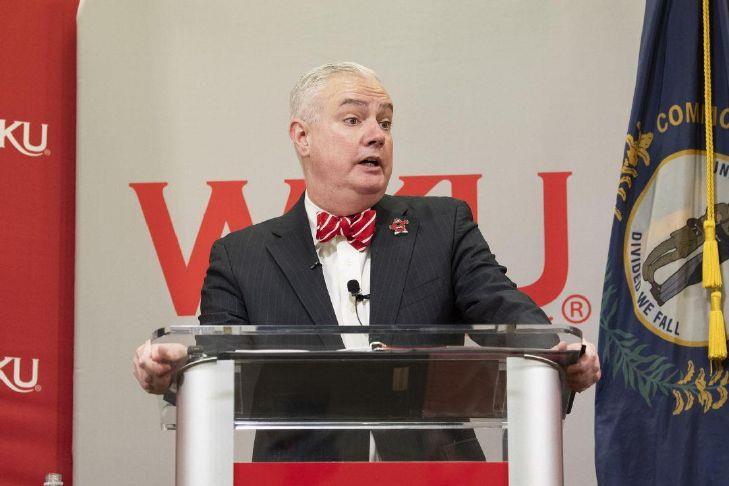
Western Kentucky University President Tim Caboni shared updates on these and other topics in a Van Meter media conference Tuesday.
He opened with accomplishments: Retention hit 79.4%, almost Western’s 80% goal, while the graduation rate nears 60%, a nearly 8-percentage point increase since Caboni began presidency in 2017. The four-year graduation rate surpassed 50% — a higher percentage than that of the Research-1 University of Louisville, Caboni added.
He credited numerous initiatives: living-learning communities, where students with similar interests, particularly academic, have shared a residence hall floor; centralized first-year advising at Downing Student Union; scheduling financial aid offers earlier; using predictive modeling to attract students; shutting down a program for students with sub-2.0 GPAs, and adding WKU’s Summer Scholars program to support students with 2.0-2.5 GPAs; and the honors program.
WKU reported $11 million in its Higher Education Research and Development Survey — the most for its research and development since data collection began in 2010, Caboni said. And as Western moves toward becoming a Research-2 Institution — requiring the R&D funding alongside additional doctorates — it’s anticipating a data science PhD program by fall 2027.
The biggest facility reveal last semester came in the 113,000-square-foot Gordon Ford College of Business at Amy and David Chandler Hall.
House Bill 4
Western Kentucky University has concluded its state-mandated review of alumni or off-campus groups due to Kentucky House Bill 4, which WKU determined as being applicable to the Society of Black Alumni, WKU Topper Pride Alumni Chapter and the WKU Sisterhood.
The Republican-majority Kentucky General Assembly last legislative session enacted HB4, which effectively bans diversity, equity and inclusion initiatives. Part of it entails prohibiting public higher ed institutions from “providing differential treatment or benefits on the basis of an individual’s religion, race, sex, color, or national origin,” according to its legislative summary.
WKU stated that it had previously given the groups three choices: change their makeup to comply with HB4, disaffiliate from the university, or dissolve. Western’s general counsel along with committee members reviewed organizations and went to outside counsel to determine the organizations, Caboni said.
The Society of Black Alumni disaffiliated, while WKU Topper Pride dissolved, according to Caboni. Also due to HB4, WKU on Friday disaffiliated with the WKU Sisterhood, an organization of women who’ve raised more than $1 million for WKU-associated programs in what it describes as an unbiased manner.
The WKU Sisterhood will dissolve after distributing remaining funds to WKU programs, charities or elsewhere, as most members haven’t expressed wanting to maintain the organization without university support, WKU Sisterhood Chair Debra Sowell said.
“We’re going to comply with the law,” Caboni said. “I’m so thankful for the Sisterhood and the work that they’ve done to support the university, thankful for their investment in our people and our programs.”
Caboni added that HB4 “actually forces (WKU) to be “much more granular, and in some ways, much more effective … Instead of looking at broad categories, how do we use predictive modeling and other things that we know about students to help us direct that funding?”
Caboni stated that no other groups are currently under review for compliance.
“… thankfully, we’re at the end of that process,” he said.
Housing, facilities
The temporarily shuttered Normal and Regents halls are on schedule to be opened by fall 2027, Caboni said. Hilltopper Hall’s demolition is slated for once summer begins.
Following its recent $5.8 million pre-development agreement with the Gilbane Development to pursue WKU’s multiyear housing plan, WKU aims to take down Douglas Keen and Hugh Poland Halls over the summer and begin on a 1,000-bed facility.
“We know that student expectations have shifted for housing over the past decade, and that our housing stock today does not match the expectations of our students and our family, and so we needed a national partner to help us move quickly to replace the housing that we have and to improve the stock on the buildings we’re going to renovate,” Caboni said.
Following an initial plan to demolish the historic Faculty House — and much pushback, — Caboni stated that the historic house is “not going to go away, to my mind.
“I think it was pretty clear that it’s an important symbol for an institution. One of the things that we have to maintain are those symbols, and so we’ll figure out what the use is, if any; if not, it may just stand as a symbol.”
Its future depends on what WKU’s Faculty House Committee will decide, Caboni said.
“I maintain my commitment to figuring out what the appropriate role of the faculty house is,” he added.
Concerning the renovation of Cherry Hall, Caboni said the university is bringing it “back to its original, historic condition.”
WKU also plans a dedication of the Tim and Sarah Ford Fieldhouse for March 24, which will serve athletics, forensics and esports programs.
WKU hopes to this year have renderings ready for its upcoming academic complex, for which the WKU Board of Regents filed an eminent domain lawsuit over six properties last year.
While WKU won’t comment on ongoing litigation, Caboni said, “We (…) continue to work diligently to come to a fair price, and we’re making a good-faith effort to do that with those property owners.”
Caboni said he thinks it’ll wrap up this semester, but there’s a way to go before it’s resolved.


Best of Best Winners